Why Your Brand Is Missing From ChatGPT Search, And How To Fix It

Most brands are invisible to ChatGPT, Perplexity, and Google AI Overviews not because their products are weak, but because their websites were never built to be read by machines that summarize instead of link. AI assistants pull answers from sources that state facts clearly, use structured data, and are already trusted enough to be cited elsewhere. If your site relies on vague marketing copy and no schema markup, you are handing the citation to a competitor who did the technical work.
What Does It Mean When AI Search "Misses" Your Brand
When someone asks ChatGPT, Gemini, or Perplexity a question related to your industry and your brand never comes up, even though you rank on page one of Google, that is a visibility gap between traditional search and generative search. These are two different systems with two different rules. Google's classic algorithm rewards backlinks and keyword relevance. AI assistants reward clarity, structure, and confidence in the source, often summarizing content instead of sending a click.
This matters because a growing share of research and buying decisions now start inside a chat window instead of a search bar. If your brand only exists in Google's blue links and not in AI generated answers, you are losing the exact moment when a buyer is comparing options and forming an opinion.
For B2B companies especially, this shift is easy to miss because the traffic loss does not show up as a dramatic drop in a dashboard. It shows up quietly, as fewer inbound inquiries relative to search volume, or as prospects arriving already favoring a competitor they discovered through an AI generated comparison. By the time the gap is noticed, the competitor has often already built months of citation history that takes real time to match.
Why AI Assistants Skip Certain Brands
There are five common reasons a well established brand still gets skipped by generative engines.
1. The Content Is Vague Instead Of Specific
AI models are trained to extract facts, definitions, numbers, and clear claims. A homepage full of phrases like "industry leading solutions" or "trusted by businesses everywhere" gives the model nothing concrete to quote. Compare that to a sentence like "AFC Furniture Solutions offers a 10 year structural warranty on its Adaptable desk range," which is specific, checkable, and quotable.
2. There Is No Structured Data
Schema markup (Organization, Product, FAQPage, Article) tells search engines and AI crawlers exactly what a page is about in a machine readable format. Without it, the model has to guess at context using unstructured text, which increases the chance it picks a competitor's page that made the meaning obvious.
3. The Site Has Weak Entity Signals
AI systems build what is called a knowledge graph, a web of connected facts about people, companies, and products. If your brand name is spelled inconsistently across your site, your social profiles, and your directory listings, the model may treat these as different entities and fail to connect the dots. Consistency in naming, address, and description across every platform strengthens your entity signal.
4. There Is Nothing Recent To Cite
Generative engines favor content that looks current and actively maintained. A blog that has not published in over a year, or a site with outdated statistics, signals to the model that the source may be stale. Regular publishing with dated, factual updates keeps a brand inside the pool of citable sources.
5. The Brand Has No Third Party Validation
AI models cross reference claims. A brand that only talks about itself, with no reviews, press mentions, case studies, or external citations, looks less trustworthy to a model trained to weigh corroboration. Genuine third party mentions, even a handful of strong ones, carry real weight.
How AI Assistants Actually Choose What To Cite
Generative engines like ChatGPT and Perplexity typically combine a live web search with their trained knowledge, then rank sources using signals that overlap with, but are not identical to, traditional SEO. The signals that matter most are:
- Clarity: does the page answer the question in the first few sentences
- Structure: is the content broken into headings, lists, tables, and short paragraphs
- Authority: does the domain have a track record of accurate, cited information
- Freshness: is the content recent or recently updated
- Machine readability: does the page use schema markup and clean HTML
None of these require a massive marketing budget. They require a website built with intent.
It also helps to understand that generative engines do not treat every page on your site equally. A pillar page that thoroughly answers one central question will usually outperform ten thin pages that each touch the topic lightly. Depth on a single, well organized page signals expertise in a way that fragmented content cannot match. This is one reason a strong technical foundation, covering crawlability, page speed, and clean HTML, tends to produce better AI visibility results than adding more pages alone.
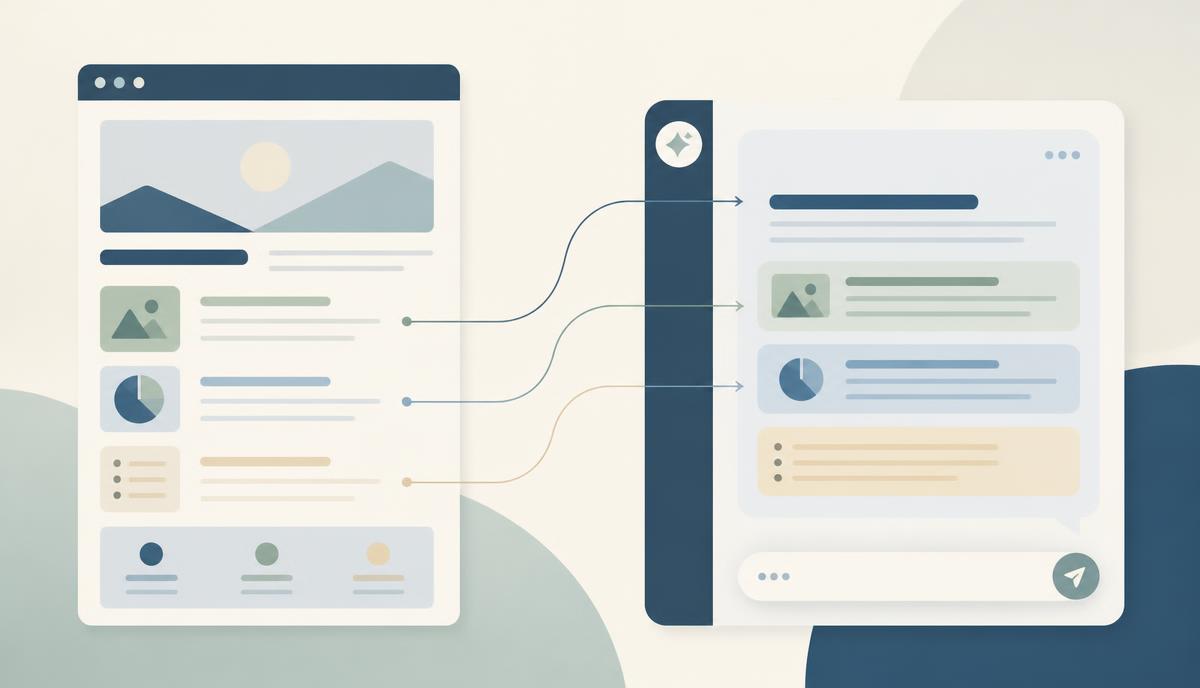
The Fix: A Practical Checklist To Get Cited By AI
Step 1: Audit How AI Currently Sees You
Ask ChatGPT, Perplexity, and Google's AI Overview the exact questions your customers ask. Note whether your brand appears, what gets cited instead, and what language those competing sources use. This single exercise usually reveals the content gap immediately.
Step 2: Rewrite Key Pages With Direct, Extractable Answers
Every important page should answer its core question in the first 40 to 60 words, in plain language, before going into detail. This is the single highest leverage change most sites can make.
Step 3: Add Schema Markup Across The Site
At minimum, implement Organization schema on the homepage, Product or Service schema on offer pages, and FAQPage schema anywhere you answer common questions. This gives AI crawlers a direct, unambiguous source of facts about your brand.
Step 4: Build An llms.txt File
An llms.txt file is a plain text summary placed at the root of your domain that tells AI crawlers what your site is, what it offers, and where the most important pages live. It is a newer standard, but an easy, low cost way to make your site easier to interpret at scale. There is a full walkthrough in this guide to building an llms.txt file.
Step 5: Strengthen Entity Consistency
Make sure your brand name, address, and description match exactly across your website, Google Business Profile, LinkedIn, and any directories you are listed in. Inconsistency confuses the entity graph that AI models rely on.
Step 6: Earn Genuine Third Party Mentions
Guest posts, press coverage, podcast appearances, and industry directories all give AI models a reason to trust claims that your own site makes about itself. Even a small number of high quality mentions can shift how a model treats your brand.
Step 7: Publish Consistently With Real Data
A blog that shares real numbers, real case studies, and real outcomes, published on a steady schedule, gives generative engines fresh, specific material to cite. Recycled generic content rarely gets picked up.
How To Measure Whether Your AI Visibility Is Improving
Traditional analytics tools were not built to track AI citations, so measuring progress here takes a slightly different approach.
Manual prompt testing. Keep a running list of the questions your buyers actually ask, then run them through ChatGPT, Perplexity, and Google's AI Overview on a monthly basis. Track whether your brand appears, how it is described, and which pages get cited.
Referral traffic from AI platforms. Google Analytics 4 can segment traffic by source. Watch for visits arriving from chat.openai.com, perplexity.ai, and similar referrers. This traffic is usually small in volume but high in intent, since the visitor already read a summary and chose to click through.
Search Console impressions for question style queries. Even though AI Overviews often satisfy a search without a click, Google Search Console still logs the impression. A rising number of impressions for "what is," "how to," and "best" style queries is a useful proxy for growing AI visibility, even before clicks catch up.
Brand mention tracking. Tools built for GEO tracking, along with simple manual checks, can confirm whether your brand name, statistics, or claims are being referenced accurately when a model answers a related question.
Common Mistakes Brands Make When Trying To Fix This
Chasing keywords instead of answering questions. Generative engines are not matching strings the way older search algorithms did. Writing to satisfy a keyword density target, rather than genuinely answering what a buyer wants to know, produces content that models tend to skip.
Adding schema markup that does not match the visible content. Schema should accurately describe what is already on the page. Markup that overstates or misrepresents content can actively hurt trust once discovered by either users or crawlers.
Publishing once and expecting lasting results. AI visibility, like traditional SEO, rewards consistency. A single well optimized post rarely moves the needle on its own. Sustained, factual publishing across months is what tends to shift how often a brand gets cited.
Ignoring the technical foundation. No amount of great content will get crawled and cited if the site is slow, blocks crawlers by mistake, or has broken canonical tags. AI crawlers, like traditional search crawlers, need a technically sound site to reach the content at all.
A Real Example Of This Working
A B2B furniture manufacturer that had almost no visibility in AI search results implemented structured data, rewrote its category pages with direct answers, and began publishing case study driven content. Within a few months, the site began appearing in Google AI Overviews for multiple product related queries, something it had never achieved before. The technical fixes did not change what the company sold. They changed whether machines could understand and trust what the company was already saying.
Frequently Asked Questions
What is AEO and how is it different from GEO?
AEO, or Answer Engine Optimization, focuses on getting direct answers featured in search results, voice assistants, and featured snippets. GEO, or Generative Engine Optimization, focuses specifically on being cited by AI systems like ChatGPT and Perplexity that generate original summaries rather than list links. The two overlap heavily but GEO places more weight on structured data, entity clarity, and citation worthy content.
Do I need schema markup to appear in AI search results?
Schema markup is not strictly required, but it significantly increases the odds. It removes ambiguity for crawlers and gives AI models a clean, structured source of facts, which is exactly what these systems prefer when choosing what to cite.
How long does it take to start appearing in AI Overviews or ChatGPT answers?
Most sites see early movement within 4 to 12 weeks of implementing structured data, direct answer formatting, and consistent publishing, though timelines vary based on domain authority, competition, and how much content needs to be rebuilt.
Can a small or new website ever get cited by AI assistants?
Yes. AI models weigh clarity and specificity heavily, which levels the playing field for smaller sites that write precise, well structured, fact based content, even without the domain authority of a larger competitor.
Is AI search replacing traditional Google search?
Not entirely, but it is capturing a growing share of research and comparison queries, especially "what is," "how to," and "best option for" style questions. Brands that ignore this shift risk losing visibility at the exact stage where buyers are forming their shortlist.
Should I still invest in traditional SEO if I focus on AEO and GEO?
Yes. Traditional SEO and AI visibility share the same foundation of technical health, clear content, and authority signals. Very few tactics work for one and actively hurt the other, so the two should be treated as one connected strategy rather than separate projects competing for budget.
Want your brand cited in ChatGPT and AI Overviews?
Schema, entity signals, and answer-first content structure, done for you.